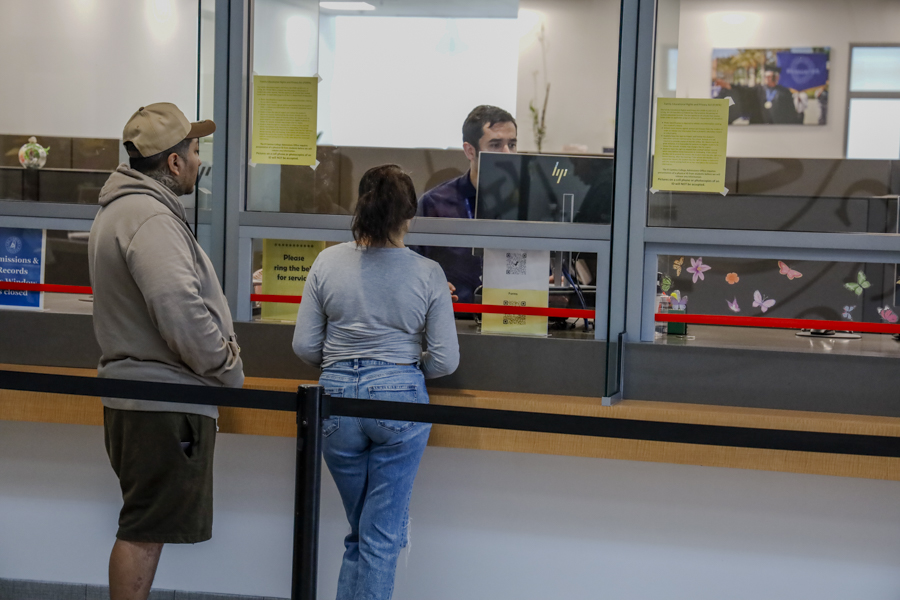
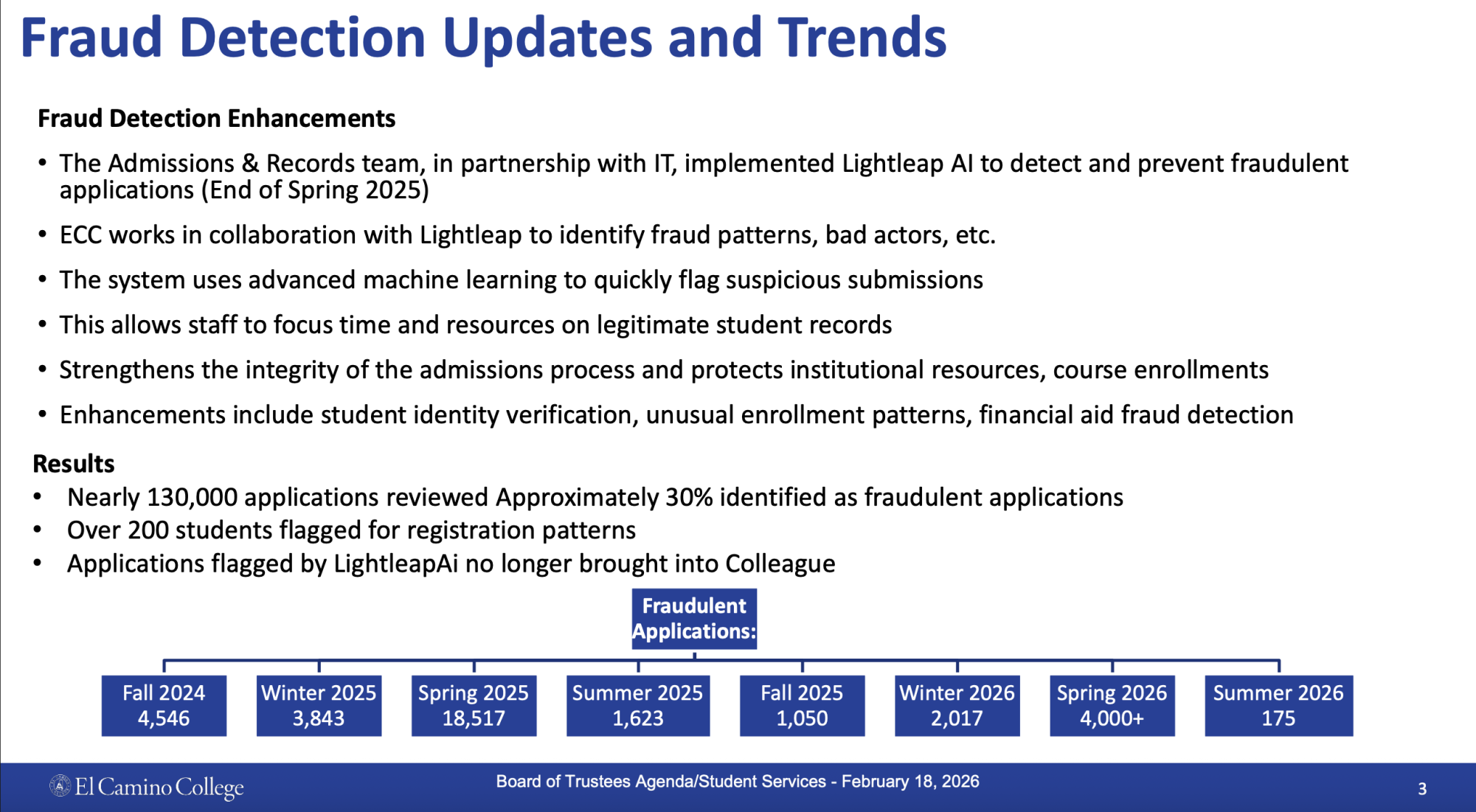
More than 4,000 spring 2026 applications were identified as fraudulent, according to a presentation from Acting Dean of Enrollment Services Dr. Kristina Martinez at the Feb. 18 Board of Trustees meeting.
Since it was first introduced for the spring 2025 semester, artificial intelligence software LightLeap AI has improved the accuracy of El Camino College’s enrollment numbers due to its success in identifying fraudulent applications and enrollments, according to Martinez.
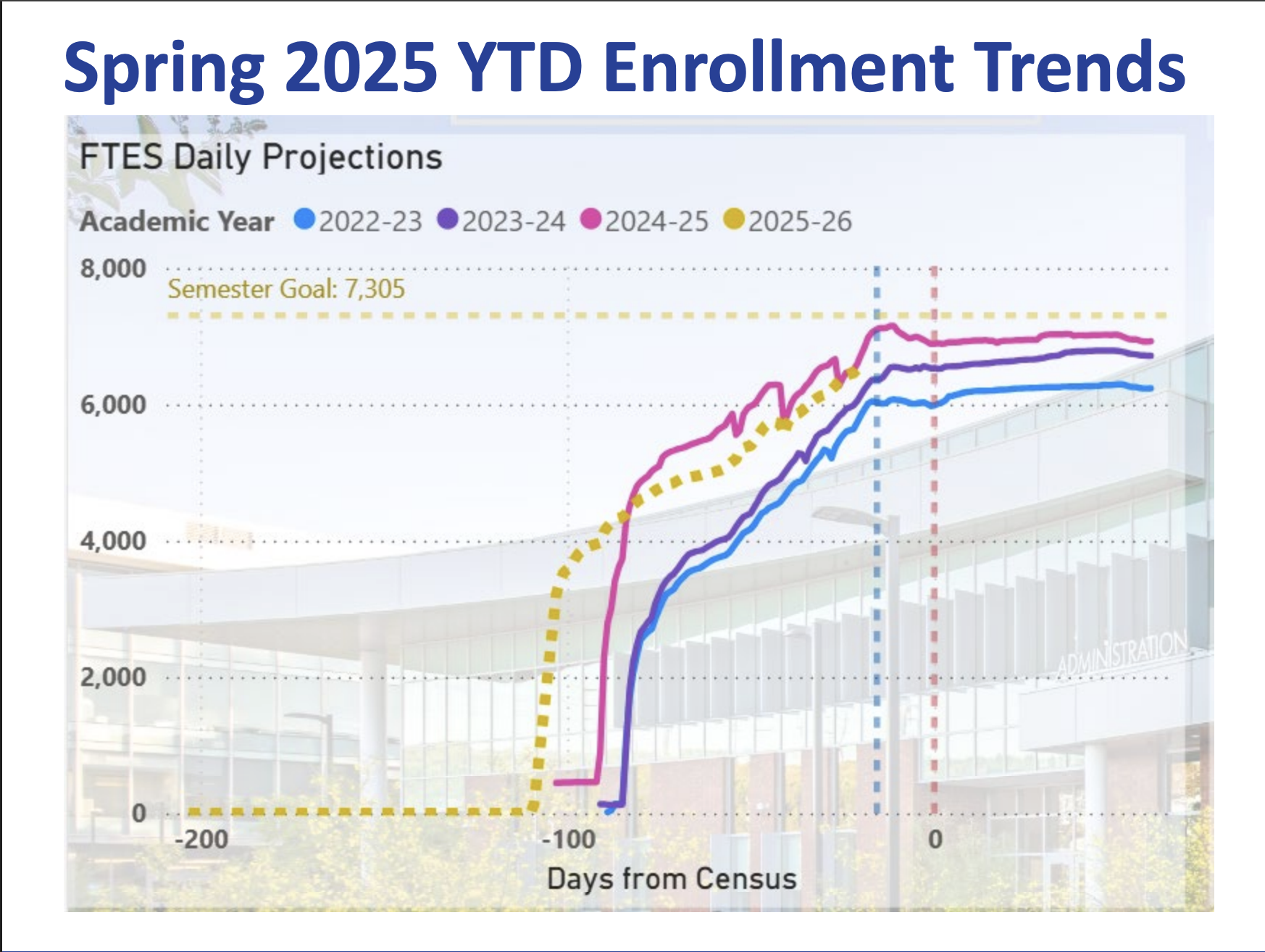
“Since implementing LightLeap AI, we’re able to prevent those fraudulent applications from coming into the system… this year you can see there’s a much more natural curve of enrollment,” Martinez said.
Fraudulent applications and enrollments have, in past years, been a prevalent issue for community colleges. According to previous reporting from The Union, 116 community colleges across California have started implementing LightLeap AI in an effort to tackle this problem.
Director of Public Information Kerri Webb said that community colleges using this artificial intelligence software are becoming more successful in catching fraudulent applications.
“We’ve noticed that not only at El Camino, but at other colleges as well who have instituted this type of technology, that the numbers of fraudulent enrollment have gone down so significantly,” Webb said.
Vice President of Academic Affairs Carlos Lopez said that ECC is in a better position with enrollment numbers than it was last year, when fraudulent enrollments were more widespread.
A metric used to measure student enrollment is full-time equivalent students (FTES). Enrollment predictions for spring 2026 hope to reach 7,305 FTES.
According to Lopez, ECC currently has around 6,800 FTES.
Student enrollment numbers are critical to managing ECC’s current budget deficit of roughly $4 million, according to Chief Technology Officer Loic Audusseau.
In his budget presentation to the board, Audusseau explained how ECC’s deficit management currently hinges on three conditions: meeting projected enrollment targets measured in FTES, continued state funding support from Proposition 98, and maintaining strong expenditure control.
“The administration continues to increment recurring, monitoring, reconciliation, and corrective mechanisms designed to detect and address these variances early on,” Audusseau said.
Failure to meet these conditions runs the risk of further budget restrictions for hourly staff, student workers, bulk orders, conferences/travel, and potentially, a hard hiring freeze, among other cuts according to the presentation.

Other important highlights from the meeting include:
- An update on the Chemistry building remediation and construction efforts appeared on the agenda and informed that construction efforts are stalled until approval is granted from The Division of the State Architect‘s office, according to item 17.4.
- More than 10 fire alarm panels at ECC will be reformed after an updated contract with MDC Engineers was passed. The $168,000 contract includes developing and implementing a new system that aims to bridge all fire alarms panels in a singular network.
The next Board of Trustees meeting will take place at 5 p.m. on Wednesday, March 18, at the Kenneth A. Brown Board Room in the Administration Building.