While attending El Camino College, Briauna Hollingsworth found herself taking in-person classes for only three semesters. The rest were done online.
The 22-year-old marketing major, who moved to North Carolina in September, is currently finishing her last semester online before transferring to the University of North Carolina at Charlotte.
She said that online classes better suited her need to balance school and work.
“I just needed the flexibility that distance education gives me,” Hollingsworth said.
Hollingsworth is just one of the 73.2% of students who were enrolled in at least one distance education class for the 2024-2025 school year.
Not only are more people enrolling in distance education classes at ECC, 85.9% of students who enrolled in 2024-2025 completed their classes, compared to 84.7% for the 2023-2024 academic year.
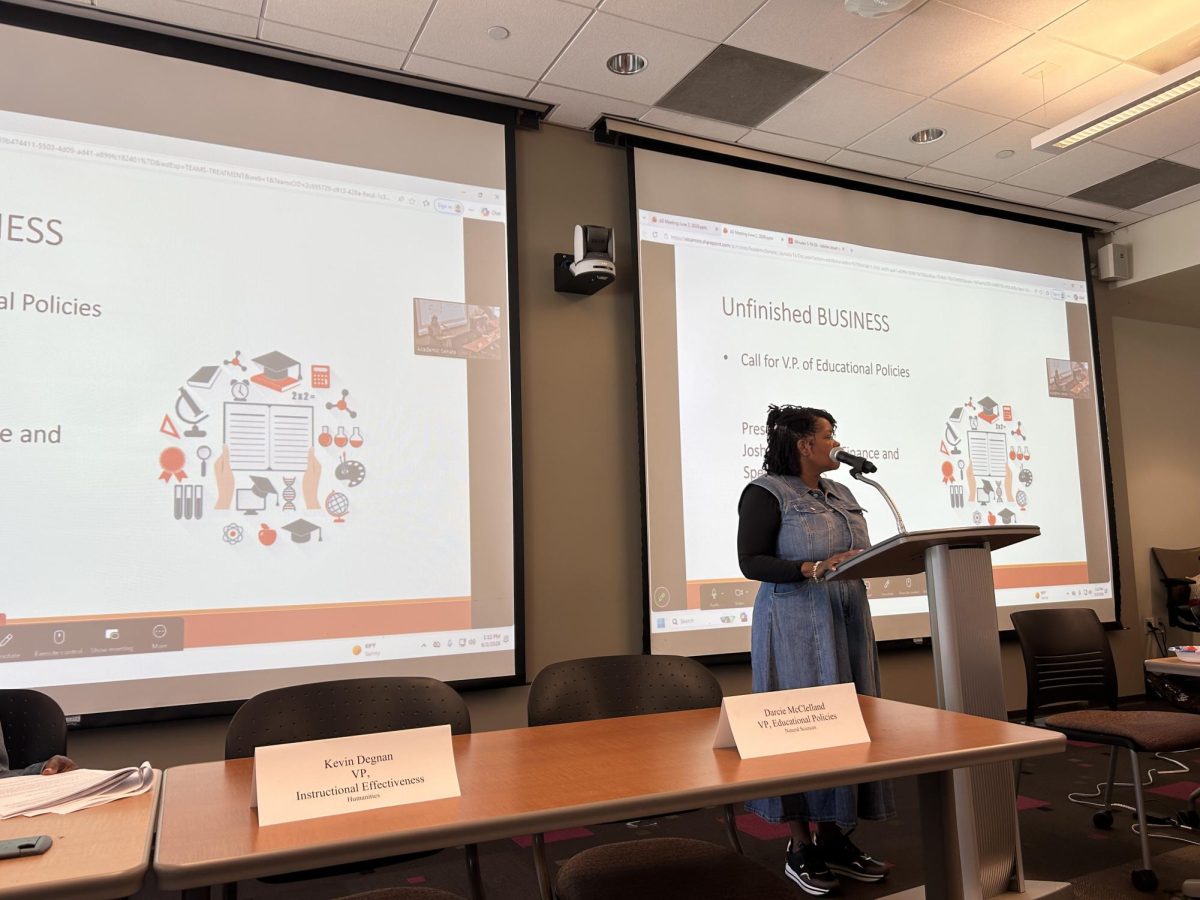
Distance Education Faculty Coordinator Moses Wolfenstein presented his findings before the board of trustees during the Wednesday, Oct. 27, session at the Kenneth A. Brown Board Room in the Administration Building.
“There is a persistent interest in online courses from our student body,” Wolfenstein said before the meeting.

When asked what is driving that interest, Wolfenstein said he couldn’t pinpoint an exact answer, but that he suspects it has to do with students being more comfortable with taking online classes.
Wolfenstein said if an in-person class couldn’t work with their schedule, then the student would just enroll in the class online.
“We haven’t done research to be able to back that up,” he said. “That’s just my intuition.”
The total percentage of students enrolled in at least one online class had dropped from 97.7% in 2020-2021, when students switched to online learning during the pandemic, to 69.5% in 2023-2024 before spiking back up to 73.2% the following year.
The rates at which students are completing online courses — with an “F” grade or better — have “generally trended up” from 83.5% for 2021-2022 to 85.9% in 2024-2025, which is more than during the pandemic.
However, the success rate — meaning the number of students receiving a passing grade — for online classes was at 69.5%, which is less than the 74.2% rate for students enrolled in on-campus courses.
As students continue to enroll in online classes, this could mean more improved regular and substantive interactions (RSI) during accreditation audits.
It was first approved by the Academic Senate for asynchronous classes in September, however a pilot program began running anonymous checks on courses as far back as Spring 2024, Wolfenstein said.
As Wolfenstein broke those figures down by race and ethnicity, board of trustees President Trisha Murakawa asked if the data on Asian students was disaggregated.
After the meeting, she went into further detail, citing that there are different Asian ethnicities including Vietnamese, Filipino, Thai and Japanese.
“He gave us the data, but it wasn’t disaggregated, and so it just said Asian,” Murakawa said. “If you look at the demographics within just the Asian category, we could have the highest performing in the same group as the lowest performing. We don’t know.”
The data has to be disaggregated for more accuracy, so that the board of trustees can provide more resources, assistance or services to make sure students are succeeding.
“It would be great if you could show us disaggregated data next year or the next report, just to see how we’re doing,” Murakawa said to Wolfenstein during the meeting.
For Hollingsworth, taking online classes has helped her achieve her academic goals while she worked in the airline industry, first at the Los Angeles International Airport and then in Charlotte.
“Being able to have these opportunities to bolster my experience while getting my education is important to me,” she said.