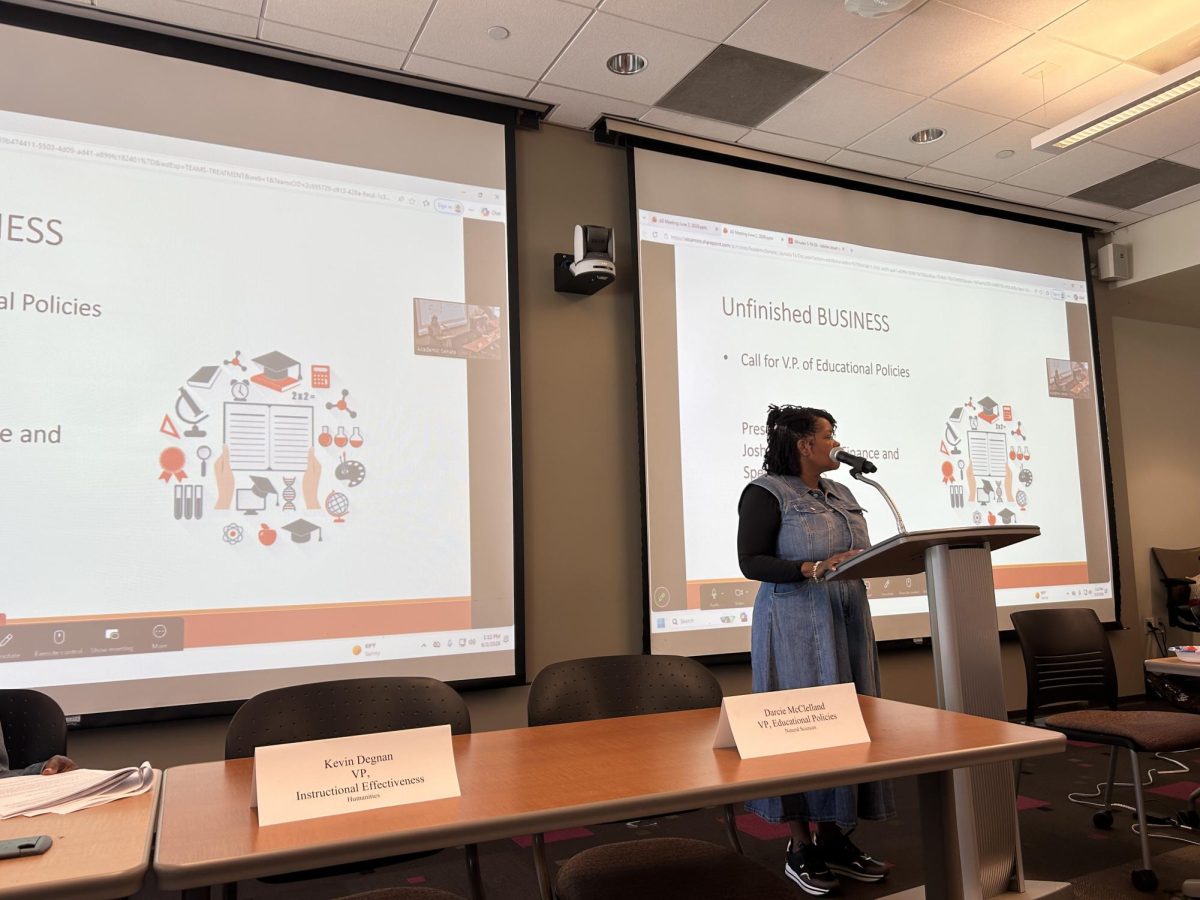
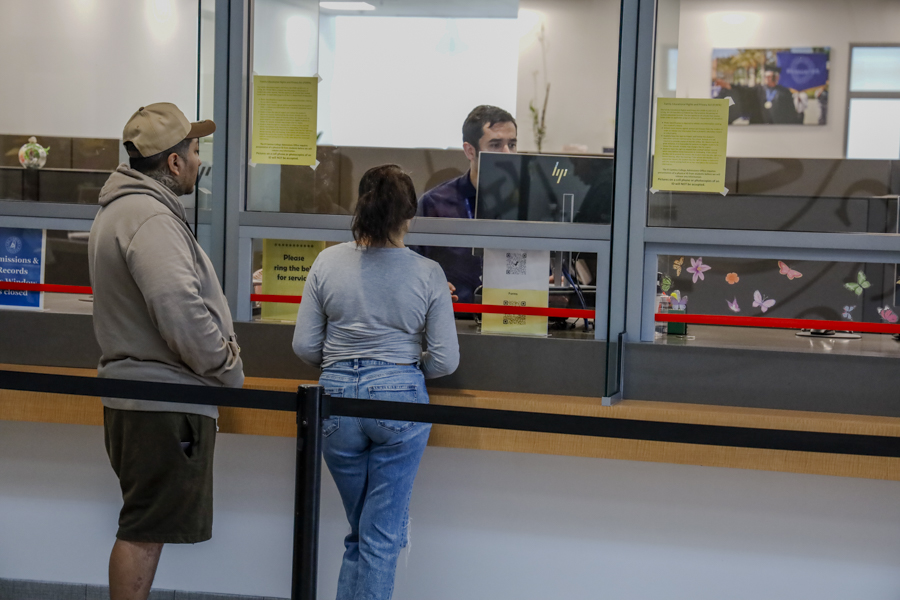
Fraudulent student enrollment and funding challenges, through possible cuts to federal student grants and programs, were presented at the College Council meeting Friday, Sept. 12, at El Camino College.
Out of over 100,000 student applications submitted to El Camino since the 2023-24 academic year, nearly 30% were marked as suspicious after a review by the fraud detection program LightleapAI.
The artificial intelligence program, developed by Georgia-based N2N Services, detects enrollment fraud in higher education by running applications against a set of criteria.
“That 30%, most students get through because it’s showing legitimate data and if it’s flagged, it’s usually a yellow,” Jeff Stephenson, vice president of Equity and Student Services, said during the meeting.

Students with applications marked as potentially fraudulent are notified to verify themselves by uploading identification, including a passport from any country, meeting over Zoom or coming to campus.
Fraudulent enrollment involves the use of stolen identities to apply for and receive financial aid including federal Pell grants, according to reporting from The Union.
“It’s just verifying that that person is a person,” Stephenson said during the meeting. “A lot of times with the flags … when we ask them to verify their identity, they never show up, they don’t ever come on Zoom or they don’t challenge it.”
All 116 community colleges across California have implemented LightleapAI to combat widespread fraudulent enrollment, according to publicly shared emails from the California Community Colleges Chancellor’s Office.
Stephenson said the software previously flagged some actual students and that staff are continuing to program the technology so it doesn’t mark real applicants as suspicious.
College Council members raised concerns that the flagging system may prevent or discourage undocumented students from enrolling if they do not have identification.
“We don’t want to turn actual students away, so that is why we are trying to be very careful,” Stephenson said.
Monica Delgado, Social Justice Center coordinator, said after the meeting that she would like to see if the software’s automated correspondence could be reviewed in terms of language.
“I do fear that … if we are using automated language that it could be creating barriers for students who want to be enrolled or maybe are afraid to provide documentation or show up to something that’s from an automated email,” Delgado said.
Fraud detection also comes at a cost when it lowers enrollment numbers.
California community colleges receive funding from the state based on a Full-Time Equivalent Students calculation, which counts a college’s full-time students by cumulatively considering the units enrolled in by all students.
ECC currently has 300 less Full-Time Equivalent Students than it had last year, according to its 2025-26 budget.
Carlos Lopez, vice president of academic affairs, said during the meeting that fake students who applied prior to the years reviewed may still be in the system.
Federal grant may lose funding
ECC may no longer receive payments for a $2.9 million federal grant, according to an announcement from the federal government released Wednesday, Sept. 10.
The U.S. Education Department intends to end discretionary minority-serving institution grants, including the Hispanic Serving Institution grant, which ECC was awarded in 2023.
English and math tutoring, Supplemental Instruction coaching and other academic resources — including faculty professional development — are funded by the grant, which requires a recipient college to maintain a quota of at least 25% Hispanic students.
Funding is received in five yearly installments from October to September.

Lopez said during the meeting that funding under the grant will continue until September 2026.
“They didn’t pull our money from this year ’cause they couldn’t legally, and we don’t believe they will be able to pull our money long term either,” Lopez said.
While mandatory funding is legally required to continue, discretionary funding is not.
If the funding ends in September 2026, ECC will lose out on about 40% of the award, or approximately $1,173,480.
Crystle Martin, dean of Library and Learning Resources, said that contingency plans are being developed for if the funding is lost.
“Mostly for math and English, we’re looking at what they would be if the funding was taken away. We only learned yesterday,” Martin said. “It’s so new, and we’re not sure what the entire implications will be.”
A campus email acknowledging the Education Department’s announcement was sent from the President’s Office earlier Friday, Sept. 12.
“It’s very early on. [The Education Department] made a lot of decisions that they’ve had to reverse. We expect that this will be another one of those, but right now that’s where we are at,” Lopez said during the meeting.
Pell grants hang in the balance
An impact to Pell grants, which the U.S. Education Department awards to low-income undergraduates to pay for college and necessities, may result from the One Big Beautiful Bill signed into law July 4.
“We are monitoring the One Big Beautiful Bill because it actually will affect some financial aid,” Stephenson said during the meeting. “Everybody is trying to work through that on how it impacts our students.”
Stephenson said the college will keep everyone informed as more information is received from the state, the Department of Education, agencies and higher-education focused organizations.
“They are the ones sending information about possibilities, but we don’t have any concrete details,” Stephenson said after the meeting.
At ECC, about 33% of students — close to 10,500 students — were Pell grant recipients in the 2023-24 academic year, according to the college’s Annual Factbook.
Fraudulent enrollment has already impacted how students receive Pell grants.
The U.S. Education Department began an effort in June to prevent financial aid fraud nationwide by strengthening verification processes in the fall 2025 semester.
“[The effort is] to protect taxpayers while significantly reducing the administrative burden on colleges and universities,” according to its announcement.
Studio art major Ray Lashley, 21, said receiving a Pell grant for two semesters, receiving over $2,000 each time, helped him immensely in his situation.
“It’s just so helpful … It helps me be able to eat and like, afford necessities … I was able to get my laptop, get my drawing tablet … and it makes it so much easier to complete commissions so I can earn a little bit of extra money,” he said.