

Parking Lot L at El Camino College was once lined by the cars of students and employees. Now, bright orange and white traffic cones barricade a space that has more life than ever.
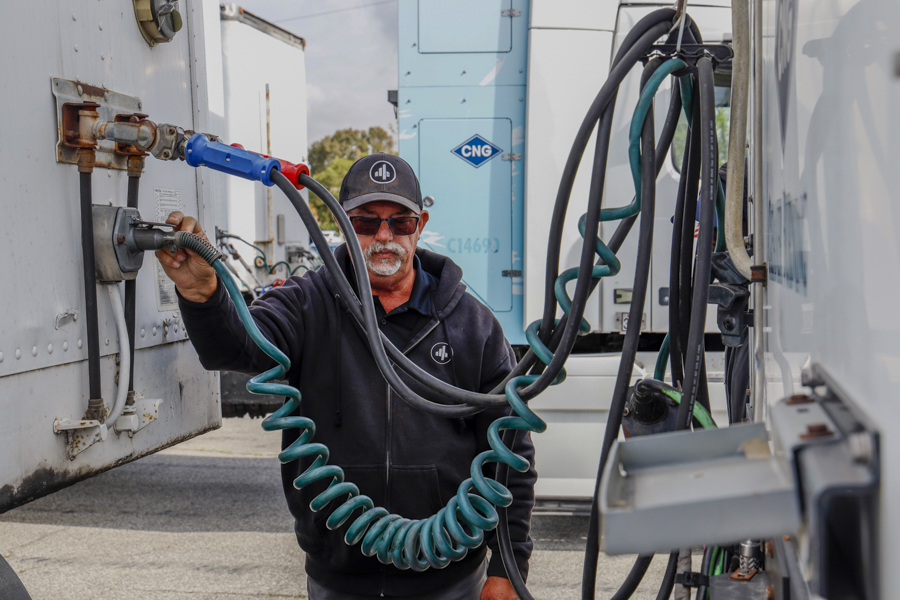
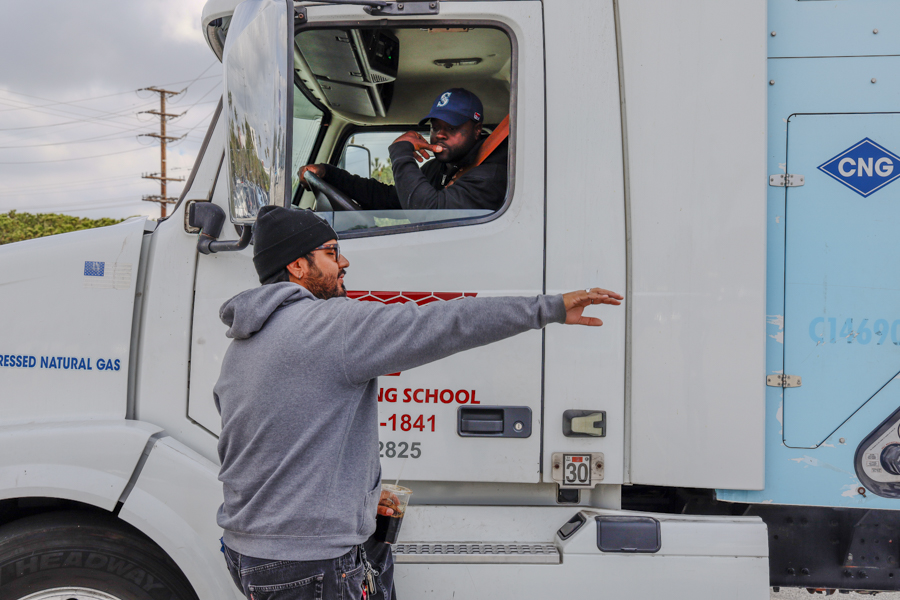
The sun rises and it’s brisk. By 8 a.m., the lot is filled with 18-wheelers. Students pace alongside them, holding wooden pointers and reciting pre-trip inspections as instructors watch closely.
It’s a new beginning. For some, it’s their first time around trucks. For others, it’s a career that has followed them throughout their lives.
For the past three years, El Camino’s Community and Continuing Education Department — partnered with the TGA Truck Driving School — provides students a non-credit opportunity to learn a new career in just 10 weeks.
The program’s destination is not just for students to pass their California Class A commercial truck driving licensure test, but to get a job in the industry.
For instructor Mike Evans, 56, this goal is simple.
“The main thing is a career, a job,” Evans said. “It’s more than just a license.”
Job placement is uncertain in many educational pathways, but El Camino and TGA’s partnership is built for immediate employment.
“Once they graduate, they have eight different job offers,” Evans said.
Evans, originally from Los Angeles, spent 36 years in the trucking industry before becoming an instructor with TGA at El Camino in August 2025.
Instead of hauling loads, he’s preparing students to enter the world of trucking.
Job offers after completing the program come from nationally recognized carriers, including Swift, Schneider and Western Express. Evans said those are the most frequent recruiters.
“That’s just the ones we call, but there’s more,” Evans added.
Unlike traditional academic programs on campus, the course compresses everything into two and a half months. The students begin in the classroom, preparing for permit exams and learning regulations, before heading out to Lot L — known as “the yard” — where the training becomes more physical.
Repeatedly, they walk around and point, waving their wooden pointers around like wands.
“Pre-trip is just making sure everything’s working,” Evans said. “Teaching them, showing them the materials to pass when they take the exam at the DMV.”
The repetition can feel relentless, but it’s intentional.
“It’s almost like getting a master’s [degree],” Evans said. “Maybe not as much time, but it’s a lot of effort and a lot of rules and a lot of stuff you’ve got to learn in a 10-week period.”
For graduate Gladys Kimberly Reyes, 32, this structure made all the difference.
Before enrolling in the program on campus, she had tried multiple different trucking schools. Each time, she stepped away.
“The difference that I saw in the other schools, they just give you an app and tell you [to] go take the test,” Reyes said. “I felt like it was just a paycheck for them.”
She remembers feeling lost and helpless in her three previous programs.
“I had a lot of difficulty, so I’m assuming that’s why I kept dropping out, because I didn’t have someone there to actually help me,” Reyes said.
Reyes found out about the trucking program at El Camino through a friend. It was convenient, as she was working at the Port of Los Angeles. She enrolled in the upcoming course and got to work, where she first met TGA instructor Andrea Viera.
“I met Andrea, met her team. And I was really fascinated, like, in the beginning,” Reyes said. “I wasn’t feeling lost. I was feeling really motivated.”
Reyes, a student who once felt hopeless, finally met her match with El Camino and TGA.
“I gave my 50% into actually make it. But they gave me the 50% back to understand it,” Reyes said. “That’s what made me get through the class, get through the testing and pass everything on the first try.”
Reyes graduated from the program in October 2025 and got a job with Prime Inc., a freight transport and logistics trucking company based in Springfield, Missouri. TGA helped her land this job, and she’s been driving ever since.
“I literally have not stopped,” Reyes said. “Christmas, New Year’s, Thanksgiving — I was driving.”
Not every student stays on the road after graduation, but the program can still help shape a career.
Treveon Allums, 28, is from Shreveport, Louisiana, and moved to California in late 2025. Carrying a noticeable Louisiana accent and no experience behind the wheel, he decided to take a chance with the program.
Allums was not initially a student at El Camino, but he found out about the trucking program while searching for employment at America’s Job Center of California in Torrance. The opportunity to get his commercial driver’s license and a grant caught his eye.
“The whole process was phenomenal. I’m not gonna lie,” Allums said. “Coming in, I didn’t have any experience with the trucks. They really took time to teach us about the trucks, not only how to drive the trucks, but how the trucks operate.”
He gave heavy praise to Evans and Viera. He said they were both excellent instructors who played a huge part in his experience in the program.
After completing the program in January, Allums decided to take a different route.
He decided to re-enroll as a business administration and management major at El Camino and started participating in on-campus organizations to grow his personal network.
He’s now part of the Formerly Incarcerated Re-Entry Students Thriving Program and Men of Color Action Network, while also having his own company, TAP ’N LLC, which moves freight from other companies.
Allums’ goal is to get his degree in business administration and apply his skills to his business all while exploring potential job opportunities.
Allums said he is grateful for having the opportunity to take and complete the program and sees it as a vital stepping stone toward entrepreneurship.
“I thank God for the opportunity — it was phenomenal,” Allums said.
The El Camino trucking program offers a flexible schedule, making it available for a wide range of students. Evans said he’s had students ranging in age from 22 to 58.
There are three time options for the program: morning, 8 a.m. to noon; evening, 1-5 p.m.; and night, 6-10 p.m. Classes take place Monday through Thursday and are all taught by Evans, with assistant Kevin Millones and substitute Viera.
The class variety is convenient for students in different stages of their careers. The 8 a.m. course this spring also includes Delorean Harry and Jim Hitt.
Harry, 41, born in South Los Angeles, is looking for a new beginning to his career. He spent 18 years living in Georgia and Alabama before coming back to Los Angeles last year.
“Before I even turned 22, I was in the streets out here, been to 15 funerals before I turned 19. It was depressing,” Harry said. “I went out there, had a chip on my shoulder. The South can really humble somebody.”
He came back as part of his five-year plan, which includes starting a career and caring for his elderly mother. He said that he’s already ahead of his plan.
Harry chose the morning class to have more time throughout the day to help out his elderly mother in the early stages of dementia, to better accommodate his appointments and to attend to others who depend on him for rides.
Hitt, 59, is a Torrance native and former El Camino College student not in search of a new beginning, but an advancement in his career.
A former fire science student at El Camino, Hitt is the director of operations at Code Four, a marketing company based in Huntington Beach.
The reason he chose the early morning class is to go to work afterward, where his main priority is setting up Sofi Stadium with signage for the upcoming 2026 FIFA World Cup.
“The whole reason why I’m taking this class is to drive the stage,” Hitt said. “We have a stage we move around [at Sofi Stadium].”
Getting a commercial driver’s license is both a personal and career-driven goal for Hitt.
“Well, I’ve always wanted to get a class A license, but the company [Code Four] is supporting it by paying for me to come here,” Hitt said.
Although these two are on different paths, they work as a team and share a common goal: to get a commercial driver’s license.
Harry, Hitt and a few other classmates often meet outside of class time to study. Sometimes at Starbucks and sometimes even Hitt’s job in Huntington Beach.
“When I have the opportunity where I work — we could use our box trucks as examples and study on those,” Hitt said.
They use this study time to perfect their pre-trip inspections in the midst of their grueling 10-week course.
Harry, Hitt, and their other classmates aim to complete the program in May 2026.
The trucking industry is a unique one, as it — like many others — is one that is constantly evolving while making changes to help the economy and drivers.
The biggest change in the industry since Evans started driving 36 years ago is the shift to automatic transmissions.
“Not only is it better for fuel efficiency, but it also significantly extends driver life as it’s less fatiguing on their knees,” Evans said.
Job security is a major factor that draws students to the program. For example, during the COVID-19 pandemic when many industries were facing massive layoffs, truckers stood tall. Evans has firsthand experience working through the global pandemic.
“[COVID-19] didn’t ever shut the industry down because things have to move on trucks,” Evans said.
For Dennis Haynes, a container freight station manager for the Redondo Beach-based DSD Trucking — consistency has always defined the trucking industry.
“Cargo is steady,” Haynes said. “I’ve always had that opportunity to make pretty much as much money as I really wanted to — as many hours as I was willing to work.”
Haynes, 66, started driving when he was 19. Working in the warehouse with DSD before becoming a driver, he used his skills to eventually create his own container freight station.
Haynes and DSD primarily pick up cargo from LAX, the same place where he learned to drive his truck. Work never stops at LAX.
“The planes never stop landing, so cargo is steady coming in — 24 hours a day,” Haynes said.
While COVID-19 never shut down the industry, it did reduce work.
“It affected [trucking] quite a bit,” Haynes said. “There was not as much cargo coming into LAX … the world was pretty much shut down.”
The biggest change was having to slightly cut some of his drivers’ hours. Giving them only four hours a day rather than their standard eight.
Haynes said since trucking is labeled as essential, they still had the opportunity to go out and work when others didn’t.
Security is why April 2025 alumnus Dion Geata, 44, chose to enroll in the course.
Gaeta was an aspiring actor who moved from Iowa to Los Angeles in hopes of getting his first big break.
As he grew older, he started to realize that acting jobs were getting harder to come by.
“Well, I stopped getting the roles,” Gaeta said. “Getting the auditions… for like, ‘guy coming out of the pool’ — to ‘guy coming out of the pool’s father.’”
The effect on the film industry due to the Palisades fires was the breaking point in his shift to trucking, as jobs were harder to come by.
“When the fires happened, I was looking for a change, and I decided to go with truck driving because I’d always been interested,” Gaeta said.
Growing up in Iowa, Gaeta felt like he was destined to drive trucks.
“I had family members when I was growing up who were in trucking and I grew up on a farm, so I was operating heavy machinery from a very young age.” Gaeta said. “Trucking is always one of those things where it’s kind of like in my peripheral.”
Gaeta enjoyed the challenge the course brought. Learning to use heavy machinery in only 10 weeks was an interesting experience.
“The class was great. It’s really interesting — it’s very difficult in a sense,” Gaeta said. “Ten weeks is just — it’s like, you know, you’re learning to operate heavy machinery in a very fast-paced moving environment.”
Gaeta is now happily working with May Trucking Company in Oregon. He applied to the company through El Camino, but he also applied to Werner, Swift and others.
“May is a great company. I highly recommend new drivers try out — if they can pass the tests,” Gaeta said.
Although he enjoys his job and the company he works for, it’s not all sunshine and rainbows in Gaeta’s eyes.
“I like the job. I enjoy being in the truck. I enjoy doing the pickups and the deliveries,” Gaeta said. “But as far as the industry goes, there’s a lot of things in the industry that I don’t particularly care for.”
Gaeta says the lack of regulation is a concern for him in the industry.
“You get all these promises, oh, we make $50,000 a year, $80,000 a year, so on and so forth.” Gaeta said. “Unfortunately, there is no real oversight to that.”
Other aspects of the industry also decided the paths taken. That is especially true for Villones, a TGA instructor at El Camino.
He was an owner and operator of his own LLC for five years before becoming an instructor with TGA. He chose to stay local, only going as far as San Diego to stay close to family.
“That way I’m always home every night,” Villones said. “I didn’t want the truck to absorb my life.”
El Camino partnered with TGA Truck Driving School in 2023, under a one-year agreement renewable for up to five years. The partnership has been extended through 2026 and was most recently renewed on Jan. 21.
The original contract outlined a payment structure based on students and contained three units: permit preparation, range training, and road training. In 2024, it was switched to a flat revenue rate of 15% of student registration fees.
Despite the change, the program’s finances have not shifted. Since 2023, El Camino estimates $311,952 in revenue and $228,000 in expenses, resulting in an estimated net gain of $83,952.
Viera, a TGA instructor, said TGA Truck Driving School is currently working on a program that would allow students to graduate in just five weeks.
“I’ve already graduated students within five weeks, and it’s been working out,” Viera said. “We’re just trying to make it official.”
It is unclear if El Camino College will adopt these five-week courses.
While contracts, revenue and expansions shape the future of the partnership, the impact is visible every day in Lot L.
The sun sets and it’s cold. By 10 p.m., the lot is still filled with 18-wheelers as students put away their wooden pointers and head back to their cars while instructors also pack up for the night.
Lot L isn’t what it once was. It is now a concrete ground for stability, advancement or even a new beginning.
For students like Kimberly-Reyes, it’s proof that the right environment can mean all the difference.
“I wasn’t feeling lost,” Reyes said. “I was really feeling motivated.”