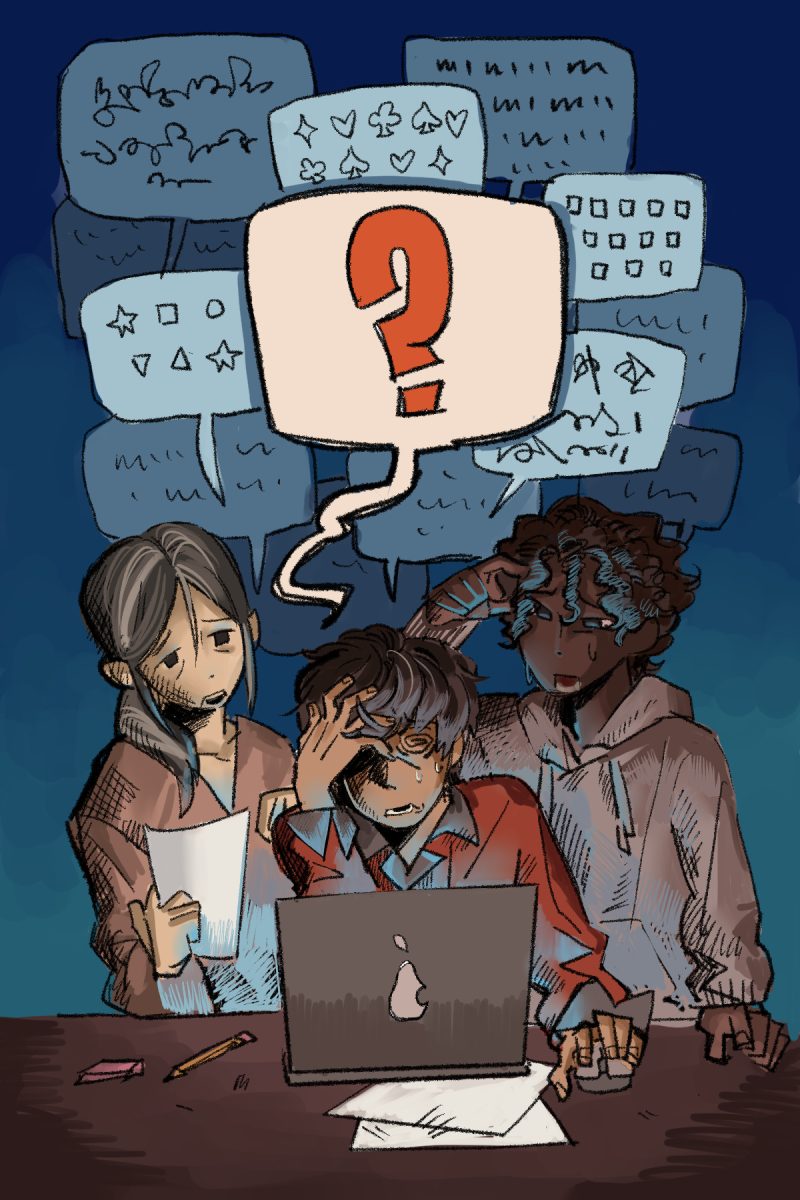
Silence in the classroom doesn’t signal a lack of preparation or interest for many college students learning in a second language.
In a recent journalism class, my professor discussed the importance of using detail in reporting and describing gestures, tone of voice and body language.
As she spoke, I had a simple thought: it sounded like creative writing. It wasn’t a complicated idea, but I couldn’t express it.
I kept repeating the phrase in my head, wondering whether “creative writing” was the right expression. While other students participated in the discussion, I remained silent.
When I finally felt ready to speak, the conversation had already shifted. I had the right answer, but the moment had passed, leaving behind feelings that were a mixture of frustration and discouragement.
Moments like this are common for students learning English as a second language.
About 18% of American college students in 2022 had a native language other than English, according to data from Genio‘s New Majority learner report.
Falling silent often reflects the pressure of those speaking in a language they have not yet mastered and the extra effort required to do so.
The fear isn’t just of giving the wrong answer. Sometimes it’s about trying to avoid expressing the right idea in the wrong way.
Often, I start by thinking about the idea, then I translate it and adjust the grammar until the sentence sounds right.
Even small mistakes, such as using the wrong preposition, an incorrect verb tense, or mispronouncing a word often make me feel anxious and nervous when I speak.
These errors that seem insignificant can be magnified in a college classroom.
In a quick, fast-paced class discussion, those few seconds can make all the difference.
As a result, silence is frequently misinterpreted. Professors may see it as a lack of preparation while classmates may interpret it as a lack of interest.
In many cases, it is simply hesitation.
At El Camino College, this quiet struggle affects more students than most might imagine.
In my experience, when I talk to classmates in similar situations, we share the same challenges.
The campus, which has an ESL program, reflects a strong linguistic diversity, but language barriers can still influence academic progress.
College becomes just one more responsibility among a list of others.
Another group facing language challenges is called “Generation 1.5,” a term introduced by sociologist Rubén G. Rumbaut of the University of California, Irvine.
It refers to immigrants who arrived in the United States as children or teenagers.
Countless speak English fluently in everyday life, but still struggle with academic writing, research papers and formal essays.
El Camino offers resources to help. The Reading and Writing Studio offers individualized support with grammar, organization, and academic writing.
However, support outside the classroom doesn’t solve everything. Challenges often arise during classroom discussions.
Professors can help by allowing brief pauses for reflection or giving students a moment to organize their ideas and thoughts before responding.
These adjustments don’t lower academic standards, but they can make participation less intimidating.
Students, too, also need to take risks. Confidence usually develops after someone decides to speak up.
After a class where I remained silent, I scheduled a meeting with my professor and explained that I was still adjusting to English and, at times, needed more time to express my ideas. The conversation helped.
I felt more at ease speaking in class after that, even if I wasn’t always confident.
It wasn’t me making excuses for not doing the assignments. I simply wanted to explain my situation.
After that, I felt more comfortable participating. I started speaking more often, even knowing that my grammar might not be perfect.
The classroom should be a place where mistakes are allowed. Mistakes are part of learning. The silence I felt that day wasn’t due to ignorance. It was hesitation.
The difference lies in the extra step between thinking and speaking. In a classroom built around discussion, this small delay can cause voices to fall silent.
Recognizing this gap doesn’t mean lowering expectations. It means understanding that intelligence sometimes pauses while searching for the right word.
And yet, it still deserves to be heard.