I’m on my way to work.
I realize I forgot something.
A drug.
Do I stop to get it and make myself late?
If I don’t, the rest of my day will be miserable. My pounding head and lack of focus will make the day’s responsibilities feel much worse.
If I do, it will make me late.
I put my credibility on the line.
That’s an addiction.
But it wasn’t a hard, illegal drug I needed. It was a Ghost energy drink with 200 milligrams of caffeine.
I consume all sources of caffeine — energy drinks, black coffee, espresso shots — whatever will get the job done. I am dependent on it to get through the day.
Now, imagine if that same dependence wasn’t on caffeine, but on a substance like nicotine or even cocaine, and it was still sold at nearly every convenience store in America.
This feeling I have must be normal, right?
Everybody needs their morning cup of coffee.
Caffeine addiction is real, and it should be treated like any other addiction – alcohol, nicotine or cocaine.
My average daily caffeine intake was roughly 600 milligrams per day – equivalent to three energy drinks a day or six cups of coffee.
That’s a 50% increase above the Food and Drug Administration’s recommended amount of 400 milligrams per day, equivalent to one and a half energy drinks or four cups of coffee.
College students consume more caffeine than the rest of the American population, about 800 milligrams a day — about four energy drinks or eight cups of coffee, according to a 2021 study.
It is easy to understand the stress and workload of a student considering school assignments and other responsibilities they may have.
Caffeine’s accessibility is the gateway to addiction that many college students fall into.
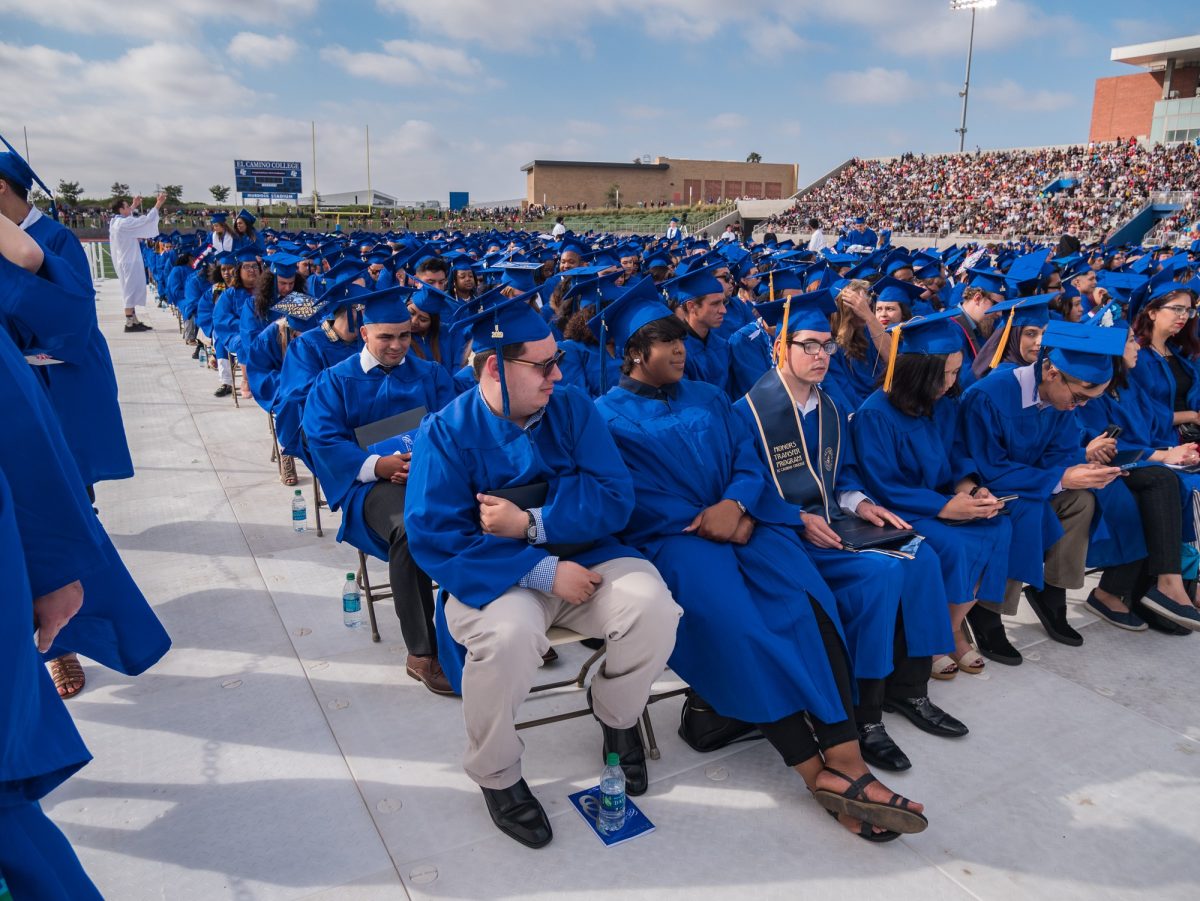
Caffeine is a readily available drug across El Camino College.
You can find a coffee or an energy drink at the Bookstore, Cafe Camino, and every convenience store near campus. I usually pick one up at 7-Eleven on the way to campus.
I was 19 when I had my first energy drink. A little boost before going to the gym after work wouldn’t hurt. I thought that everybody does it, right?
I didn’t drink much caffeine growing up. I always enjoyed the flavor of coffee, but refrained from it because I was always told by my family that it would stunt my growth, which is a myth, according to a Harvard Health article.
But beyond myth, overconsumption of caffeine has real health risks.
It can cause heart palpitations, high blood pressure, insomnia and more symptoms according to an article by the Food and Drug Administration.
Not only is too much caffeine not great for your health, but it’s also not great for your wallet.
A drink from a coffee shop is about $5. Buying a coffee or energy drink five times a week can end up costing over $1,000 a year.
My first energy drink was an orange cream-flavored Ghost — my favorite flavor combination, and a flavor I still to this day can only find in energy drinks.
It had a unique taste I’ve never tried before.
The taste, along with the buzz it gave me during my workout, kept me coming back.
“Only before the gym,” I told myself to refrain from getting hooked.
I stood by that for about a year until I got a job working the overnight shift at Target when I was 21. That’s when caffeine went from being a recreational habit to a part of my lifestyle.
Energy drinks went from a boost for the gym, to keeping myself awake for my overnight shifts, to something I had to drink in order not to have a headache.
Today, caffeine feels more necessary than ever. Every week, I work six days and go to the gym four times on top of being a part-time student.
My morning coffee and pre-workout energy drinks are mandatory.
As someone who’s always had a weakness for sweets and soda, some of the flavors were hard to resist. Maybe I wouldn’t have dug this hole for myself if there weren’t so much variety.
Young adults between the ages of 20 and 24 represent 30% of El Camino students who are still developing habits that they will carry with them for the rest of their lives.
Caffeine abuse awareness should be spread in the same way as other substance abuses.
El Camino’s 2022 Biennial Review of the Drug Free Schools and Communities Act states that the college “is committed to having a drug and alcohol free campus.”
The campus has taken steps to stop other substance abuse. Just last year, the restrooms in Schauerman Library’s East Basement were closed due to students using them to smoke.
Some policies and acts focus on drugs like alcohol and nicotine, but caffeine isn’t in that discussion. Based on a study by the Sleep Foundation, 94% of American adults consume caffeine. Many, like me, have made it a part of their lifestyle.
Although caffeine is highly addictive, I do not think it should be banned. Those mornings — like the ones where skipping that stop on the way to work feels impossible — are only proof of how powerful it can be.
I do not plan on quitting any time soon.
My doctor says I’m healthy, and I still crave the extra boost it gives me to handle my responsibilities, but I am cutting down my usage. Instead of 600 milligrams a day, I aim toward 400 milligrams, the FDA’s recommended daily limit.
To protect my wallet, I’ve started buying Ghost energy drinks in bulk from Costco and making my own coffee at home.
People are busy and I am too, and sometimes we need that extra push to keep ourselves going.
Unlike other drugs, caffeine itself is not bad; the abuse and overconsumption are what turn a simple boost before the gym into a daily necessity.