Before ChatGPT became the ghostwriter for essays, school assignments were sloppy, genuine and chaotic expressions of student creativity and knowledge.
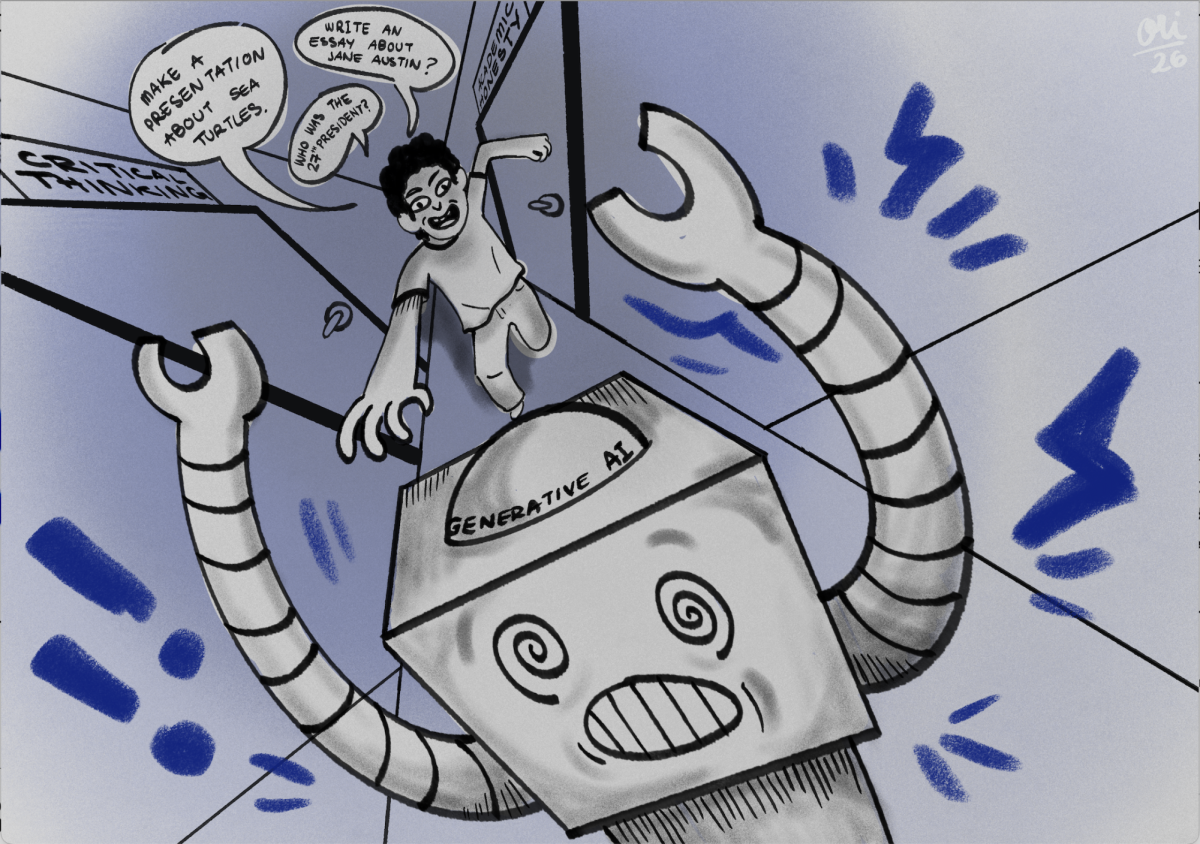
Now, eerie soulless writing and work can be seen across all El Camino College’s different academic divisions. Students are killing their creativity and critical thinking skills by relying on AI platforms to do their work for them.
The Higher Education Policy Institute found in a 2026 Student Generative AI Survey that 95% of students report utilizing AI in school, with 49% finding it useful. “The biggest risk when it comes to AI…is the type of relationships that kids, teens and young adults are going to build with AI,” Chief Technology Officer Loic Audusseau said.
Students on campus admit to having used or knowing colleagues that use AI to complete school work.“I have a lot of friends that use AI often, many,” radiology major Raul Monje, 18, said.
Many point to the slew of harmful effects AI can have on the brain and to social spaces. A study conducted by neurotechnology specialists at the MIT Media Lab in Cambridge, Massachusetts found, in examining neural activity while using ChatGPT and other AI platforms, that usage was directly linked to weaker deep cognitive processing, memory retention and reading comprehension.
“In the long run it will affect their cognitive thinking for sure…they’ll be more reliant on AI, which isn’t good…take baby steps backwards and start using your own cognitive function for your own good and career,” Monje said.
While AI usage drains our brain, it also drains the world’s water supply. Large data centers that help develop AI models can consume upward of 5 million gallons of water per day, according to the Environmental Energy Study Institute.
That amount equates roughly to the water usage of a small town of 10,000-50,000 people. AI isn’t frying its motherboard anytime soon, so students should adapt to create a healthier balance with AI usage.
Digital detoxing can be an especially effective tool for students addicted to AI and overall technological usage. It’s a return to more traditional outlets for a period of time, cutting all forms of online technology, even for a short time. “I do think people these days are becoming more reliant on using AI for everything… even just daily apps have AI implemented into it,” Kamiya Williams, an 18-year-old undecided major, said.
It’s not that students should completely avoid AI, but instead make it a responsible behavior that can be encouraged. Studies show that mental health, attention span and general well-being improved after two weeks of blocking mobile internet.
While no one these days is expected to go two weeks off-grid, students are unable to go a day, let alone an hour, without a device in hand. Education is a choice and it falls on students to create discipline in their relationships with AI and set themselves up for good brain function for the future.