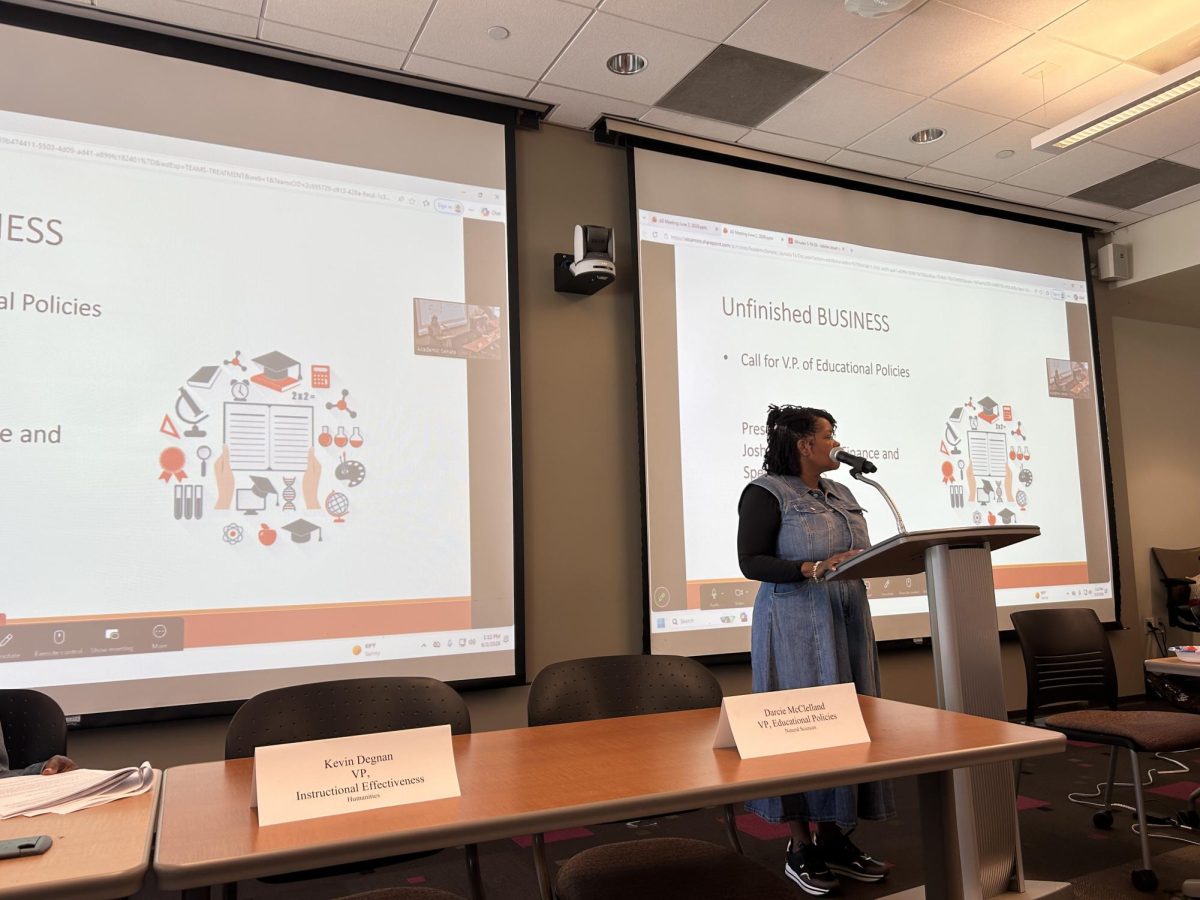
In a unanimous decision, the El Camino College Academic Senate approved drafting a resolution regarding the use of artificial intelligence grading tools for instructors Tuesday, Oct. 21, in the Distance Education Center.
The new business item was presented by Vice President of Academic Technology Stephanie Burnham, who sought senate feedback on the two ways to go about implementing AI policy in the educational system.
“What I’m seeking today about these AI grading tools…is not the discussion yet, but just which format we want that discussion in,” Burnham said.
Besides passing a resolution, the other alternative was amending AP 3775, which is a separate administrative procedure regarding the school’s AI policy that is currently undergoing discussion.
“I am highly in favor of a resolution and not a policy because things are going to change so much,” Sargent at Arms Josh Troesh said.
AI is increasingly becoming a necessary tool in the workspace, with other community colleges and schools quickly adapting AI policies to the change.
Long Beach City College recently adapted their AI policies, BP and AP 3775, this year, according to their website.
“Just as we’re writing ours, we look to see what other people are doing…everybody’s in the process of writing theirs too,” Burnham said.
Much of the impact on students from this upcoming AI policy will vary by discipline, Burnham said.
“It’s like we’re all building the planes as we’re flying it, as we’re looking around to see what other people, how other people are building their planes,” she said.
Marc Yeber, a full-time architecture professor at ECC, provided one such example of how AI usage varies depending on discipline and how instructors are already utilizing AI in the classroom.
“We embrace AI…we’re using it as a tool for the design process, not a tool to come up with a solution,” Yerber said. “At least what it does is it spurs creativity.”
Soon, the senate will be presented with a first reading of the AI resolution, where it will be met with critiques and feedback.
This process will continue until the senate can decide and pass a final version that will be implemented.
The senate also approved revisions to AP/BP 4226, the policy concerning overlapping enrollment, in a two-thirds majority vote.
The revision limits overlapping enrollment courses to 20 minutes a week.
The decision addresses the concern amongst faculty, especially part-time and non-tenured instructors who feel the administrative pressure to catch up students on their own time, with no pay, and who miss significant portions of class time.
“There are some faculty who don’t feel like they can say no…there are part-time faculty or non-tenured faculty who are being asked to do an hour or more a week,” Sargent at Arms Darcie McClelland said.
The next Academic Senate meeting will be held Tuesday, Nov. 4 in the Distance Education Center from 12:45 to 2:15 p.m.