Conservative activist Charlie Kirk, 31, was killed by a single gunshot on Wednesday, Sept. 10, at a tour event taking place at Utah Valley University in Orem, Utah, according to the Associated Press.
A 22-year-old Utah man who opposed Kirk’s views, Tyler Robinson, was arrested and charged on suspicion of murder as of Tuesday, Sept. 16, according to the Associated Press.
Kirk, who co-founded Turning Point USA in 2012, was known for hosting “Prove Me Wrong” tables at college campuses, debating controversial topics with students and the public in an open-mic format.
TPUSA is a non-profit organization that promotes conservative politics at high school and college campuses nationwide.
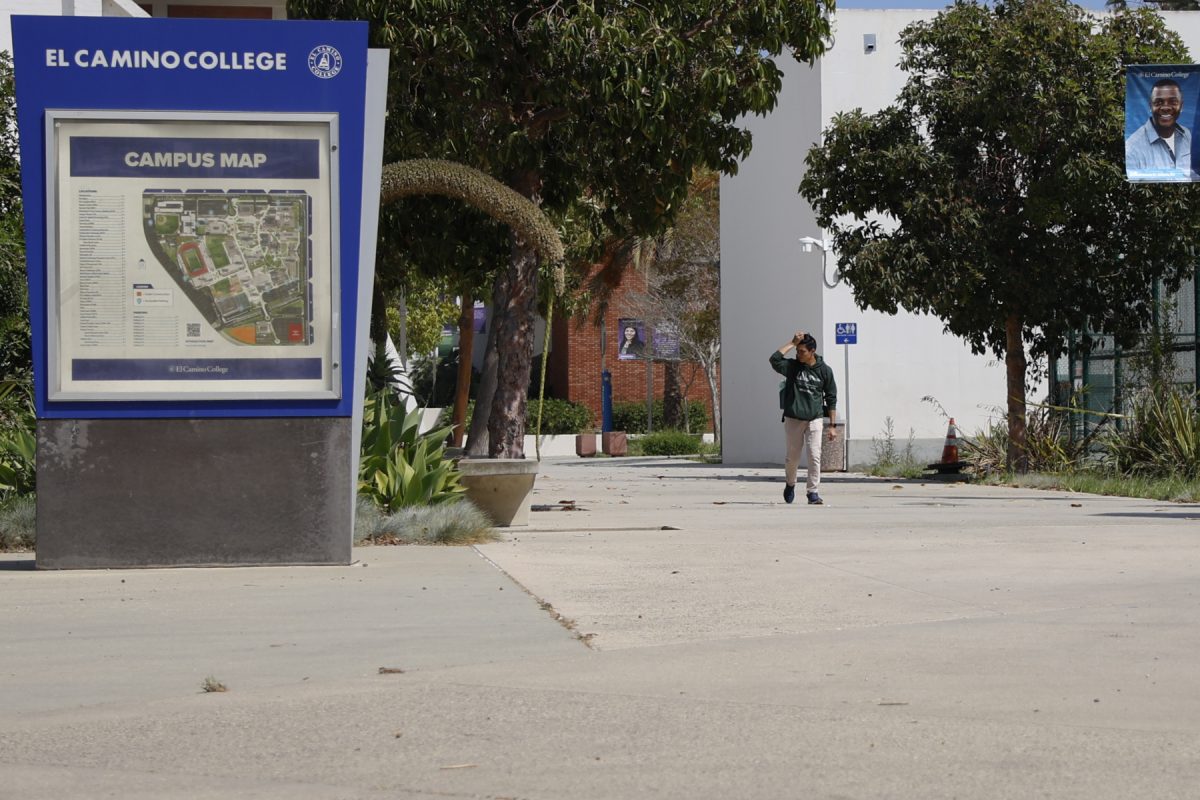
A representative of the organization visited El Camino College’s campus briefly on Sept. 10, independently tabling in an open area during the last day of Club Rush.
“We didn’t know they were going to be out there today, which is kind of set up as part of the free speech policy,” student activities adviser Tyler Strohl said.
The representative was seen setting up for the event before its 11 a.m. start time. However, the organization left around noon, about an hour after Kirk was shot.
The number of times TPUSA has tabled on campus is unknown.
“Even though our office is the home for people signing in for free speech [activities], we don’t patrol and go around and look —- kind of outside of our role — so I’m not sure how often they’ve been here,” Strohl said.
The Union reached out to TPUSA’s regional manager, Berkley Corey, and submitted a media inquiry form to TPUSA, but did not receive a response.

Prior attempt to form a TPUSA club on campus
Turning Point USA at El Camino College was approved as a student organization by the Associated Students Organization in fall semester 2024.
“We were active and we were official,” former club president Kumayl Nazary, 32, said. “Everything was done in an official capacity following the instructions given to us by El Camino College.”
Nazary, who no longer attends ECC, said the club faced challenges that other clubs didn’t experience, and that their first adviser resigned with two months left to the semester.
“There were a lot of advisers who wanted to take on that role but hesitated or refrained from doing so because of the backlash they knew they were going to get from other advisers, their peers and other faculty from the institution itself,” Nazary said.
Ricky Gonzalez, Student Development Office director, told The Union the club was never official as it did not find a faculty adviser nor finalized paperwork.
“They did have some meetings, but that’s how we were able to kind of catch the error,” Gonzalez said.
Gonzalez said non-club organizations are not allowed access to campus facilities, and that it was not known if students were staying back after class or if faculty left rooms open for the club.
“The deans eventually caught on to it and … we started to kind of deconstruct everything,” Gonzalez said.
Flyers with ECC’s logo appeared on campus in fall 2024 for the club, including one that advertised a meeting in Behavioral and Social Sciences Building Room 200 at 1:15 p.m. on Tuesdays.
Nazary said the Student Development Office would approve the club’s flyers, but that there would be a last minute “nitpicky” issue that would prevent the club from advertising.
“[Having a faculty adviser is] one of our requirements, so they were told they can’t be a club on campus,” Strohl said. “From there, like any free speech organization, … they can exist as Turning Point USA in any public domain. They just weren’t able to use the college logo.”
Gonzalez said the club later met at patios after being restricted from using classrooms.
“El Camino College wasn’t the most welcoming place for the club and this is only in retrospect that i can say this,” Nazary said.
The Student Development Office created an unpublished ECC Engage page for the club after receiving initial paperwork, but Strohl said it is hidden because the club is inactive.
Nazary said he started the club after seeing TPUSA table during Club Rush last year during the United States’ election season.
“There was a strong appetite for views on all ends of the political spectrum,” Nazary said. “I felt like our campus could use a bit of that free speech, emphasis on free speech as well.”
Nazary said the meetings were “Socratic seminars” where someone would present on a topic — including gun rights, foreign policy, euthanasia and LGBTQ matters — and people with opposing views could debate and join the discussion.
“I think our meetings were a very open and welcoming place for everyone,” Nazary said. “There was not a single meeting i ever attended where I didn’t hear completely opposing views on any given topic.”
Computer science major Daisy Sanchez, 25, believes having a TPUSA Club at ECC would make some students feel less comfortable being on campus.
“I think, I would not have been a fan of [a TPUSA Club] because it attracts a lot of hate and negativity,” Sanchez said.
There are 10 community colleges in California associated with TPUSA chapters, according to TPUSA’s website, which does not indicate each chapter’s status:
1. El Camino College
2. Mount San Antonio College
3. Palomar College
4. Chaffey College
5. Allan Hancock Community College
6. Taft College
7. San Bernardino Valley College
8. Cosumnes River College
9. City College of San Francisco
10. Sacramento City College
There are 14 universities in California associated with TPUSA chapters, according to TPUSA’s website, which does not indicate each chapter’s status:
1. California Baptist University
2. Azusa Pacific University
3. University of California, Davis
4. University of California, Berkeley
5. California State University, Northridge
6. California State University, San Marcos
7. California State University, San Bernadino
8. California State University, Chico
9. California State University, Sacramento
10. San Diego State University, Mission Valley
11. San Diego State University
12. Sonoma State University
13. San Jose State University
14. California State Polytechnic University, Humboldt
TPUSA’s website does not recognize Loyola Marymount University nor California State University, Long Beach, as having chapters, although both institutions do.
Reactions to national news, campus safety and free speech
The Union spoke to various campus community members regarding recent news, including the Sept. 10, Evergreen High School shooting in Colorado, where a “radicalized” 16-year-old student allegedly shot and wounded two students, according to the Associated Press.
“There’s definitely been an uptick in political violence. A lot of it has been targeting like, politicians of both sides,” political science professor David Reed said. “It definitely doesn’t augur well for American society because again, it’s becoming more normalized for these kinds of things to happen.”
Psychology major Elizabeth Olivares, 18, said she was shocked to hear about Kirk’s death and especially that it happened on a college campus.
“Seeing someone get shot on a campus is kind of scary. And even though I didn’t agree with his morals and … what his opinions were, I just don’t think someone should be shot,” Olivares said.
Studio art major Yuki Nguyen, 20, said people should be more understanding.
“When it comes to the assassination, people are too quick to assume. It’s very tragic,” Nguyen said. “Our world is not black and white, we all have grey areas on how we deal with things.”
Cosmetology student Karin Kobayashi, 24, is an international student who is unfamiliar with Kirk.
“So I didn’t know him at all, but my boyfriend is American, and he talked to me a lot, and I was like ‘That’s scary,’” Kobayashi said. “Shootings are not common in Japan, so it’s scary.”
Film major Tulip Illescas, 20, said they care more about the Evergreen High School shooting than Kirk’s death.
“If you speak hateful things, hateful things are going to happen to you. I don’t understand why people care so much about him dying and not everyone else,” Illescas said.
Physical education major Brandon Corley, 20, emphasized how people’s children, siblings, nieces and nephews are impacted by campus shootings.
“I can honestly say for every high school that involves a shooting or something like that, it’s beyond outrageous,” Corley said. “Parents don’t know if something like that is going to happen to their child or if they’re gonna come home safe.”
Architecture major Sarah Ortiz, 19, said she had just learned of the shootings and did not know who Kirk was.
“Personally, I think that like shooting a person in public, no matter who it is, no matter your political stance like, it’s horrible, you know?” Ortiz said.
Kenny Simkins, LGBTQIA+ Pride Center coordinator, said people should be able to have dialogue with each other without the conversation ending in violence.
“It’s unfortunate that his death has been politicized, right, I also don’t agree with the sanitization of who he was as a person, … I have an issue with mourning the loss of somebody that was so problematic but I don’t agree in any way shape or form with the political violence,” Simkins said.
Engaging in free speech on campus
Sanchez, who works at the Social Justice Center, said that free speech has ramifications.
“I think you’re free to say whatever you like, but understand there’s consequences for what you have to say,” Sanchez said. “So spewing hate and negativity is very harmful and can negatively impact campus life.”
Reed, who teaches American Government and Political Philosophy, said students should be careful with how they react to the killing.
“It’s never good when something like this happens, even when you don’t like the person that was shot,” Reed said. “Reacting with glee to something like this just kind of reinforces the division and tension that people are already feeling.”
Monica Delgado, Social Justice Center coordinator, said she has still been processing the event and that the current times are scary.
“Obviously, we don’t want to squash anyone’s freedom of speech, but how do we more civilly engage in conversation and grow to the other?” Delgado said. “Not just try to silence one or the other through violence. It’s definitely not the way.”
Delgado said she does not know if everyone agrees with the Social Justice Center‘s name, but believes its mission is to create a space for dialogue, learning and understanding — and to hopefully celebrate each other.
“We are also alike in many ways too. We are all part of the human race … I hope that our whole campus can take on that mission, to embrace all of us and not hate speech or bigotry and violence,” Delgado said.
Interns Cecilia Herrera, Ananya Iamcharoen, Frankie Jimenez and Angel Stormborn contributed to this story.
Editor’s note:
- Byline updated Tuesday, Nov. 25.