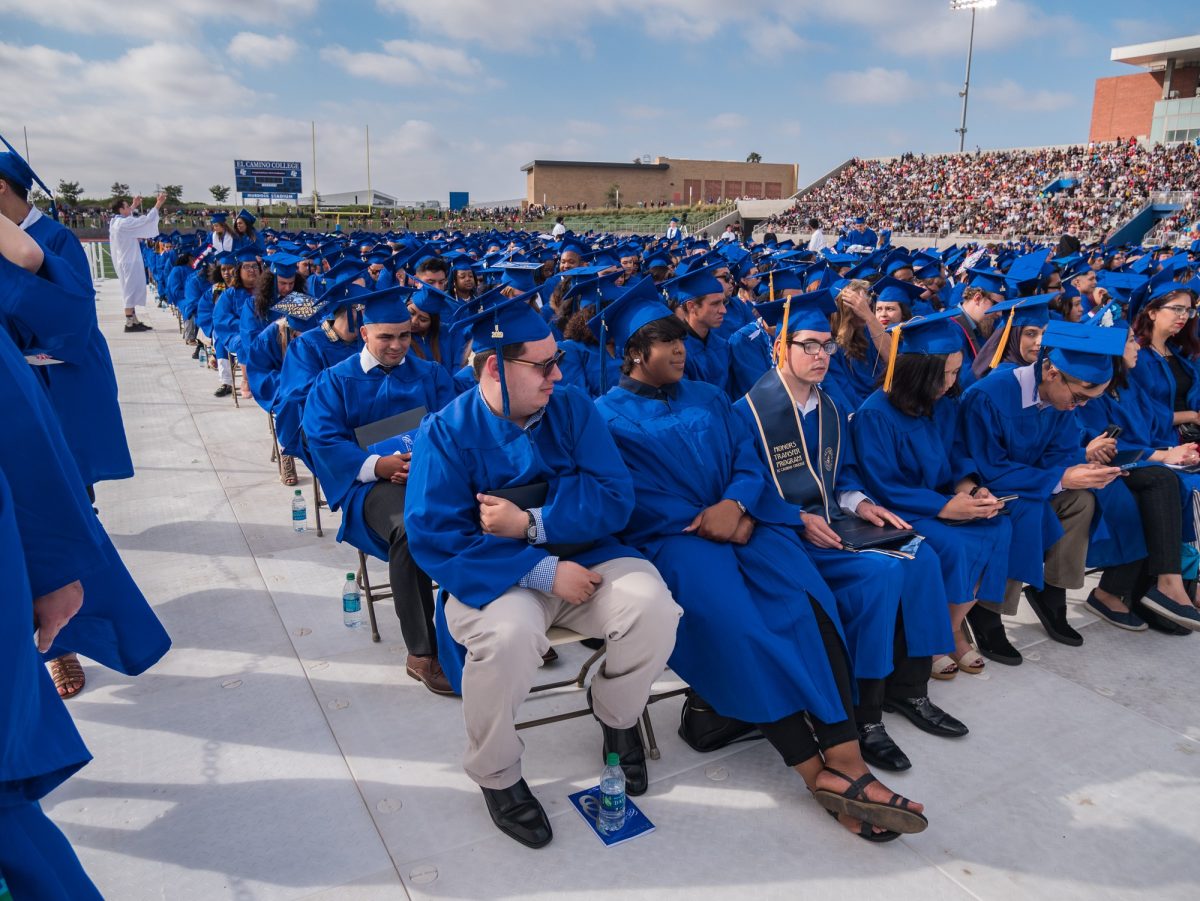
Ethnic studies curricula will continue to be further developed at El Camino College, after an update to ECC’s policies on curriculum (AP 4020 and BP 4020) was made.
This change came from the latest Academic Senate meeting on Tuesday, May 5.
“We have already been doing a lot of professional development, asking faculty in all divisions to consider a diverse array of perspectives, whether it be racial, ethnic, or different socioeconomic perspectives,” Darcie McClelland, vice president of educational policies, said.
Ethnic studies primarily focus on African Americans, Asian Americans, Chicanos, and Native Americans, and how they have contributed to the United States. These courses look at the historical background, cultural productions, and how they have contributed to society culturally.
The California Community Colleges Chancellor’s Office made ethnic studies a general required course in July 2021.
This comes after California passed Assembly Bill 1460 in August 2020, requiring students in the California State University system to complete a three-unit ethnic studies course to earn a bachelor’s degree.
Rollout of AB 1460 began with the graduating class of 2024-25.
“I think studying different ethnicities and the way they have been impacted by policies, discrimination, and racism really allows students to open their minds and perspectives to think in a way that’s broader,” social science instructor Ricardo Munguia said.
For the 2025-26 academic year, ECC is offering three types of ethnic studies courses, including ESTU 1: Introduction to Ethnic Studies, ESTU 3: The Chicano in Contemporary United States Society, and ESTU 5: Chicano Culture, according to the catalog.
Lilibeth Gutierrez, 19, a communications major, is currently taking “The Chicano in Contemporary United States Society” class to fulfill her general education requirement.
“I’m Mexican American; it’s interesting to really dive deep into certain topics and the culture,” Gutierrez said. “In schools, there’s not a big emphasis on our history. Taking a class like this makes me feel really connected to my culture.”
Yatziry Valdovinos,19, an English major who is currently taking an introductory ethnic studies course, believes it should be a requirement for everyone.
“We’re learning about things that happened back then and tying it into what’s going on now. History is just repeating itself. It’s refreshing to know that in your classrooms, everybody has different values, but we’re all similar,” Valdovinos said.
Another item on the agenda discussed during the meetings was updating the Senate Constitution.
The Senate passed a motion to remove all non-faculty members’ status from “ex officio” to “resource advisors.”
An “ex officio member,” as defined in the Academic Senate Constitution, is a non-voting member who usually serves as a resource person, advisor, or general spokesperson for other campus decision-making groups.
A change to the constitution that will be voted on at the next meeting involves how many senators each division has. The fewest senators a division can have is two, and the maximum is five.
“That’s a big change; it would be how the senators are allotted to division. The large divisions feel like their faculty aren’t being well enough represented in the Senate because the cabinet has a max of five senators,” McClelland said.
This potential change has sparked controversy and division amongst Senate members. The proposal would decrease the representation of part-time faculty.
“Our percentage of pull in terms of moving policy forward that benefits students will go from one-third to one-quarter. That presents some potential challenges. So it’s an equity issue for faculty and students,” architecture professor Marc Yeber said.